Strength Training at Home: A Beginner's Plan for Your 50s and 60s
You do not need a gym to keep your muscles. A simple two-day-a-week plan using a chair, your body weight, and a pair of light weights, based on public health guidance.
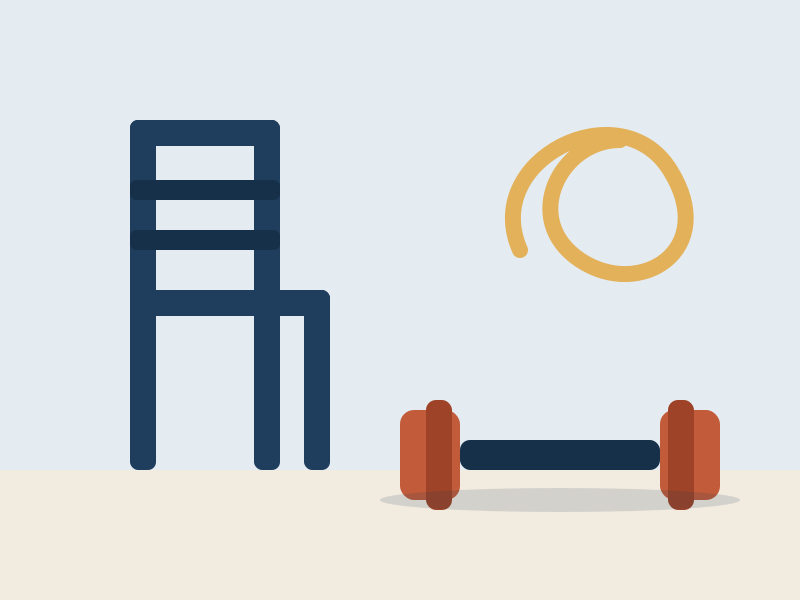
Strength training has an image problem. The phrase brings to mind barbells, mirrors, and people much younger than the readers of this site. But the version of strength training that public health agencies recommend for adults over 50 looks nothing like that. It looks like standing up from a chair without using your hands. It looks like carrying two full bags of groceries up a flight of stairs. It looks like getting down onto the floor to play with a grandchild and getting back up without a plan.
This guide offers a simple two-day-a-week plan you can do at home with a sturdy chair and, optionally, a pair of light dumbbells or a resistance band. It follows the general shape of the National Institute on Aging's exercise guidance and the Physical Activity Guidelines for Americans.
Why strength matters more with each decade
Adults who do not train tend to lose muscle mass and, even faster, muscle power as they age. The NIA describes strength exercises as a way to maintain the ability to do everyday tasks, to protect bones, and to help with balance and independence. The Mayo Clinic's strength training guidance notes that it may help preserve bone density, manage weight, and improve quality of life. These are not exotic outcomes. They are the difference between doing your own errands at 80 and needing help with them.
The encouraging part is that muscle responds to training at every age. Research summarized by the NIA suggests that people in their seventies, eighties, and beyond can gain strength with regular practice. Starting in your fifties simply gives you more years of benefit.
What the guidelines recommend
The Physical Activity Guidelines for Americans recommend that adults do muscle-strengthening activities of moderate or greater intensity, involving all major muscle groups, on two or more days a week. For older adults, the guidelines add balance training and note that when older adults cannot meet the full recommendations because of chronic conditions, they should be as physically active as their abilities allow. The World Health Organization's guidelines say the same in nearly the same words.
"All major muscle groups" sounds like a lot, but it is covered by a handful of movements: pushing, pulling, squatting, hinging at the hips, and carrying. The plan below uses one movement for each.
Before you begin
Choose a sturdy chair without wheels, ideally one with arms, on a non-slip floor. Wear shoes with a firm sole. Have water nearby. Warm up for five minutes with easy marching in place, arm circles, and gentle shoulder rolls. If you have a heart condition, joint replacements, osteoporosis, or any condition that limits movement, ask your clinician or a physical therapist which movements suit you before starting; they may suggest modifications rather than avoidance.
The plan: six movements, two days a week
Do each movement for eight to twelve repetitions, rest for a minute, and repeat for a second set once the first set feels comfortable. The whole session should take about twenty-five minutes. Leave at least one day between sessions.
- Sit-to-stand. Sit toward the front of the chair, feet flat and hip-width apart. Lean slightly forward and stand up, then sit back down slowly, taking about three seconds to lower. Use your hands on the chair arms if needed, and work toward using them less. This is the single most useful strength exercise for older adults.
- Wall push-up. Stand an arm's length from a wall, hands flat at shoulder height. Bend your elbows to bring your chest toward the wall, then push back. As it gets easier, step your feet farther from the wall or move to a kitchen counter.
- Seated row with a band. Sit with a resistance band looped around your feet, holding an end in each hand. Pull your elbows back, squeezing your shoulder blades together, then return slowly. No band? Hold light weights and perform a bent-over row, one arm at a time, with the other hand on the chair for support.
- Step-up. Using the bottom step of a staircase with a hand on the rail, step up with one foot, bring the other up to meet it, and step back down. Alternate the leading leg. This trains the hips and thighs and rehearses a movement you use daily.
- Hip hinge with weights. Stand with feet hip-width apart, holding light weights in front of your thighs. Push your hips back, keeping your back flat and knees soft, until you feel a stretch in the back of your legs. Stand back up by driving your hips forward. Start with no weight to learn the pattern.
- Farmer's carry. Hold a weight in each hand, or two full water bottles, and walk slowly for thirty to forty steps with your shoulders back and your trunk steady. Then rest. This trains grip, trunk, and the everyday task of carrying things.
Finish with a few gentle stretches for the thighs, calves, and chest, holding each for about twenty seconds.
How hard should it feel
The last two or three repetitions of a set should feel challenging but controlled. If you could easily do twenty, the movement is too light; add a small amount of weight or slow the tempo. If you cannot do eight with good form, reduce the load or the range of motion. Breathing matters: exhale on the effort, inhale on the return, and never hold your breath.
Muscle soreness a day or two after a session, particularly in the first few weeks, is normal and eases as the body adapts. Sharp pain in a joint during a movement is different; stop, adjust the range, and if it persists, ask a professional.
Progressing over the months
The body adapts to a fixed challenge within a few weeks, so the plan should change slowly over time. Add a set. Add a few repetitions. Increase the weight by the smallest increment available. Slow the lowering phase of each movement. Move from a wall push-up to a counter push-up. Step up onto a taller step. Any one of these is enough for a given week. Change one variable at a time and hold it for a week or two before the next.
A notebook is a useful companion. Writing down what you did makes progress visible and makes the next session easier to plan.
Fitting it into a week
Two sessions a week, spaced apart, is the minimum the guidelines describe. Many people pair them with walking days: strength on Tuesday and Friday, walks on the other days, balance practice at the kitchen counter most evenings. Together these cover everything the guidelines ask for from an older adult, and none of it requires leaving the house.
The long view
Strength is not something you build once and keep. It is maintained, session by session, in the same way a garden is maintained. Twenty-five minutes twice a week is a small commitment against a large return: the ability to do what you want, on your own terms, for as long as possible.
Sources
We cite public health agencies, academic medical centers, and government institutions. Links open the source directly.
- National Institute on Aging. Exercise and Physical Activity
- U.S. Department of Health and Human Services. Physical Activity Guidelines for Americans, 2nd edition
- World Health Organization. Physical activity fact sheet
- Mayo Clinic. Strength training: Get stronger, leaner, healthier
- Centers for Disease Control and Prevention. Adult Activity: An Overview
This article is for general educational purposes and is not medical advice. It does not replace consultation with a qualified health professional. Please read our Health Disclaimer and Editorial Policy.